Showing posts with label health. Show all posts

July 1, 2024

Oh, I would walk three hundred miles...

Over the last three years through hip pain and hip recovery, I have fallen out of shape and put on weight. Though I have run and biked for more than the last fifteen years, It feels like I am starting at zero, less than zero really. 

I suppose the last fifteen years are part of why now feels so difficult, so hopeless, remembering where I used to be. Still, you have to start somewhere. So I started walking. 

I set myself a goal of logging 300 miles of walking in 2024. A little under 6 miles a week, less than a mile a day. The number seemed achievable, but would still require me to get outside on a regular basis. Moving outside would do both my body and mind some good. 

I am not counting all the random steps I take, the short dog walks we take at work, or the many steps when I get out for a round of golf. Just the intentional walks, where that is why I am out there, taking steps in the right direction. 

I stayed on track for the first couple of months at the start of the year, but no surprise, fell behind in March and April as work hours increased ahead of the tax deadline. The month of May I was back to more regular walking, but I was still behind and not keeping pace. 

June it was time to get serious again, for the arbitrary challenge, but more importantly for my flailing physical and mental health. I finished out the month with nearly sixty miles on the paths and roads, and I am now at 164 miles halfway through the year. I still feel out of shape, but not quite as wildly so as I was even a month ago. 

I am doing a few things to take my health more seriously this year. The walking bit is the most concrete and easiest to measure. There have been some false starts and hiccups with each piece of the puzzle, but progress is being made. The path ahead is hopefully long, and I want to walk it with more care. 

Some photos from my June walks.


February 4, 2024

A Walk in the Woods

My friend Cherie, who has twisted my arm into biking, then into running, also got me into backpacking. 

The summer after I moved back to Washington, she invited me along on a family backpacking trip. Her dad Jim had been going to this semi-secret lake for much of his life, and in 2013 he was headed to the hills again with his daughter and grandson, a three-generation group. Cherie's husband Brian and I rounded out the pack. The hike was challenging, including a bit of hand over hand climbing, and pushing through overgrown fisherman trails, but I was pretty well hooked from the start. 

My family did a bit of hiking and camping when I was quite young, and I started camping again in my early twenties. I love so many things about it. Being outside in the wilderness is restorative. I feel so present, away from the comforts and routine of home. I actually appreciate how long it takes to make coffee and cook food when I am camping. It just seems to make me appreciate everything a bit more. 

Backpacking adds another level to it. You have to carry everything on your back, thus reducing how many comforts you want to bring along. You also have to carry this weight up and down hills, rather than just from your car to your tent. When you get to that secret or not so secret lake at the end of the trail, it feels that much sweeter that you got there under your own power. 

And once you are there, life is just so gloriously slow. You have nowhere else to be. Time to sit and enjoy your coffee. Time to wade into the mountain lake. Time for a day hike through the woods. Time to sit on a log and read, surrounded by the sounds of nature. Time to fish if you hauled that inflatable raft that nearly crushed you. Time to just be. 

I think our group has been on four backpacking trips, but it has been a few years since we headed to the woods together. Summers can fill up fast, and then the pandemic and the appearance of my hip arthritis made it a non-starter. Prior to 2020, I had applied several times to get a permit to hike the Wonderland Trail solo, but have come up empty each time. With the new hip and the limits on running, I want to get back into backpacking again.

My YouTube watchlist has been filled lately with backpacking videos, and also bikepacking videos where they trade shoes for wheels, trails for roads. Part of it is the anticipation and desire to get moving again, but I think this happens every tax season. As the hours increase, and the weekends away from work disappear, mental plans are made for the summer, something to look forward to after April 15th. 

In the meantime, and as part of the surgery recovery, I have been going on longer walks lately. The place that has become a regular favorite is Bridle Trails Park. It is a wooded oasis in the middle of the city. There are three main trails - 1 mile, 1.8 miles, and 3.5 miles, and you can mix and combine based on what you need any particular day. I choose the 1.8 when Izzy is with me, and the 3.5 when I leave her at home (much less stopping and sniffing). Every weekend it seems I find a new tree that captures my attention, and the trail is always a little different based on the weather, time of day, and level of sunshine breaking through the trees. From the name, you obviously see horses pretty regularly, but I have also seen owls and deer on my walks. 

My body and brain are better for it every time I go for a walk in the woods, even if only for an hour or two.


Scenes from this weekend.


January 28, 2024

If you can't be an athlete, be an athletic supporter


This photo is from January twelve years ago, and it popped in a nice Facebook memory last week. It is still one of my favorite running photos. The original Facebook caption is:

"Another great day on the road at the Carlsbad Marathon. New PR of 3:44:57. Thanks to my awesome support crew, including the tambourine girl who is nine months pregnant."

Tambourine girl is my friend Marci. Along with her daughter in the pink hat, and Kristy who was taking the photo, she was cheering on both her husband Sean, and me, the other Sean, as we ran the Carlsbad Marathon. Marci has run a number of marathons herself, and back in 2006 she and I crossed hand in hand at my first marathon finish line in Washington D.C., but at nine months pregnant she was obviously out for this one. 

The marathon is of course a difficult endeavor, and though you are out there fighting yourself, the course and the clock, it is rarely a solo effort. The support of your family and friends, and even random strangers cheering you on can make all the difference. I have always felt that the day spent as support crew could be just as long and difficult as those running the race. I have volunteered at a number of races and events, but haven't been on the sidelines cheering on people I knew very often, since we were often running together. I had a chance to do just that in November of 2022.

I was signed up to do the 2020 Arizona Ironman. It was of course postponed to 2021 due to Covid, and then to 2022. In the meantime, I developed arthritis in my right hip and could no longer run, so I would not be toeing the start line. However, I had three friends doing the Ironman, so I flew down to cheer them on. 

Even though I wasn’t participating, I had paid the (non-refundable) entry fee, so I picked up my gear along with my friends. Along with a bit of swag, I had the wristband that would get me some backstage athlete access on race day. 


On race day I got up early to go to the start line with my friends. It was a 3:30am wake up call to what would be a very long day. 

The Ironman distance is:
a 2.4 mile swim,
followed by a 112 mile bike ride,
followed by a 26.2 marathon distance run

As I have mentioned before, I am a sucker for the emotion of a finish line, but the start line is pretty special too. All the pent-up energy, nervousness and excitement is palpable. After months and sometimes years of training, the day is finally here. So many different stories and paths brought the varied people to this single moment. Race morning is often a bit of hurry up and wait, so you have lots of time with your thoughts before the gun goes off. I drank it all in while doing my best to support my friends Sean, Jonathan, and BG as they prepared and waited.


After seeing them off into the swim, I started my walking of the course. I went to one of the bridges to watch the swimmers go by as the sun came up, before heading to the finish line of the swim. 


The Ironman event is a pretty well-oiled machine and depends on hundreds of volunteers. At the swim finish line there was a line of volunteers there to help the wobbly swimmers get out of their wetsuits. Jonathan was first out of the water, followed by BG (who I somehow missed) and then Sean after an hour and fifty minutes of swimming. After getting out of their wetsuits, they jogged back to the transition area to start the next challenge, the 112 mile bike ride. 


The bike course was a three lap out-and-back route, so rather than try and fight the traffic and closed roads, I stationed myself about a half mile up from the turn-around. I would watch them head in at the end of each lap, then cross the street and see them again as they headed back out a few minutes later. The Ironman had a pretty good tracking app, so I had a decent idea of when each person would be coming by. Since my three guys started the course at different times and were biking at different paces, the times they came by were pretty spread out, so I was still able to duck out and get food or a cup of coffee now and then.


The riders were fighting winds for most of the ride, so the times were a bit slower than they expected. Sean was also fighting a raging headache. I had tried to find him some Tylenol or Advil between laps, but came up empty. Something to add to the support checklist for next time. 

Overall, athletes need to finish the Ironman in under seventeen hours. However, each leg of the Ironman has its own cut off time. You need to be out of the water by a certain time to be allowed to start the bike. Then you need to finish the bike ride by a certain point to be able to start the run. Since the bike route was a three loop course, you also had to start the third lap by a certain time or you would be pulled off the course. As I made my way toward the finish line and the bike turnaround, I saw the first few riders be told the heartbreaking news that their day was over. 


We headed to the bike finish to see Jonathan and then Sean come in to finish the ride. BG had started the third lap on time, but he unfortunately did not make a time cut off further down the road. He and other athletes were swept up, having already ridden 100 of the 112 miles. He was understandably pretty dejected when we caught up with him later. 

The run course was a two lap route, so we mostly stayed in one place to see Jonathan and Sean go by. Sean was slowly reeling in Jonathan on the run, but he was still struggling with the headache and of course the other aches and fatigue of all the distance he had already covered. After seeing him go by at mile seventeen, we all headed to the finish line to wait for Jonathan. 

All finish lines are amazing, but the one at the Ironman is really something special. Of course it is rewarding and emotional to be the one crossing the line, but I get choked up watching strangers finish as well. Back before I bottled everything up, one of the few things that would make me cry was watching a finish line. The Ironman did not disappoint. 

This is a moment for some random runner.


We saw both Jonathan and Sean cross the finish line, and hear their names called out by Mike Reilly followed by, “You are an Ironman!” Mike Reilly has been the voice of the Ironman finish line for 33 years, and this was the second to last race that he was announcing before retiring, so it was a little extra special to be there to hear him call out their names.


After Sean and Jonathan had some time to rest and get a bit of food in them, we gathered up their gear and made our way home. Even though we had been up close to 24 hours, we stayed up a while longer to hear stories about each of their journeys. It was such an incredible day. I desperately wished I had been on their side of the event, running alongside them, but it was still a pretty amazing day as a spectator. Wistful but wonderful.

I hope to participate in start and finish lines again on the other side of the ropes in the coming years. I am just not ready to close the door on that part of my life, which I will probably write about soon. In the meantime and near future, I will lean into the role of volunteer, head cheerleader, and/or designated domestique. 

And get me a tambourine. 


December 3, 2023

Like driving in snow

 I have been in one car accident as a driver. Well, maybe one and a half.

It sounds like it is less so today, but "back in my day" teenagers were typically champing at the bit to get their driver's licenses. Driver's ed class, learner's permit at 15 1/2, begging your parents to take you out in their car to practice driving in the Sears parking lot on the weekends. Both Mom and Dad's cars had manual transmissions, so I had to learn to drive a stick shift from the very beginning. During the driving portion of the test to get my license, I managed to stall the car before leaving the parking lot, but thankfully things improved from there and I passed. 

My driver's ed was an actual class at the high school. For some reason, I didn't take it in the earliest possible quarter. I seem to remember that some other class had taken priority. By the time I received my license, Mom was as or more excited about it. I was working at McDonald's and pretty regularly worked the closing shift. For the few months pre-license she was kind enough to come pick me up after midnight when I had that shift. The things parents do for us, that we don't fully appreciate at the time how much of a pain in the ass it was. Saints.

Around the same time, my older brother's El Camino became an additional family car, so that was the first vehicle I would get to drive on a semi-regular basis. Initially it was just to and from work, but eventually I got to drive it to other places including school. The car was one of those initial steps to independence that seemed so huge as a teenager. 

One morning I was driving to school and there was snow on the ground. Two cars ahead of me another student driver stopped mid-block unexpectedly, I think to talk to someone on the other side of the road. The car in front of me slid, but was able to stop in time. The El Camino and I, empty truck bed and wider than average rear tires, did not. After a low-speed skid into the car in front of me, the lead car took off. A rear end collision is basically always your fault, but I did internally shake my fist in the air at the driver in the first car as she sped away. 

The first car that was really mine was a 1967 Mustang. I bought it for $1,300 the day after graduating from high school. A Mustang is a classic car, but mine was more of a mutt than a purebred. Mismatched paint and parts, three speed manual, and goofy aftermarket mag wheels. But that kinda ugly classic was mine, and would be my daily driver for more than a decade. 

The Mustang had the same problem as the El Camino in the snow - rear wheel drive, and little weight over the wheels to provide any traction. I could get stuck on the gentlest of slopes, so I learned to leave plenty of room between the car in front of me, and idle slowly to red lights so that I could be still moving when the light turned green. 

One afternoon while I was driving my girlfriend home in the snow, I described to her how easy it was to lose traction in my car. All I had to do was tap the gas pedal a little too quickly, and for some reason I proceeded to provide a demonstration. Soon we were in a spin, uphill somehow, crashing ass-end against the hillside on the other side of the road. Really impressed her that day.

After a brief two year period when I had a front wheel drive Volkswagen, I was back to a rear wheel drive Dodge truck for the next fifteen years. Between the Mustang, Dodge and my previous mishaps, I learned to be a very cautious driver in the snow, even now with an all wheel drive car. Nice and easy, no sudden movements, slow and steady my friend.

One of the things I was worried about for the surgery recovery period was cabin fever. Even on normal days, I get a little twitchy if I am cooped up for long. A dog walk is an easy solution, but if it is raining too much (Izzy thinks she will melt), a drive to run an errand may happen just to get out of the house. For a few weeks post-surgery, there would be no walks or driving as a means of escape. 

Like several other worries, the cabin fever was not as bad as I expected. I leaned into the PT schedule, did lots of reading, binged a show or two, and had a number of visitors stop by to say hello or to take me out for a meal. That said, I was looking forward to being able to drive, to feel that bit of independence again. 

During a follow up visit with a surgical assistant, among other questions I asked about when I would be able to drive. The doctor said basically anytime now, as long as I was not on any narcotics (no problem there, I had given up the Oxycodone three days post-surgery). She suggested first getting in and out of the car, to see how that felt. If that went OK, to try stomping on the brake to see if that caused any pain.

After a successful "test drive" without going anywhere, I waited a few extra days before hitting the road. I first ventured out to the grocery store one evening when traffic would be lighter. A few days later, another drive to the library to restock. Next, to the office for some short, in-person work days. All the while, driving cautious and slow. Lots of space between cars. No sudden moves. 

Like I was driving in snow. 

September 16, 2023

A less crooked smile

"You don't strike me as someone who is overly concerned about how his teeth look."

This was what someone at my dentist's office said earlier this year. I have told this story to a few people, and everyone has been a bit offended for me. But it was a true statement, and I took it as such. They knew their audience I suppose. 

My teeth have always been a bit janky, with two teeth half hiding behind my two front teeth, but it has never been anything that I cared much about. When I was a kid, braces were suggested, but it wasn't for anything functional, strictly cosmetic. I of course never fully understood what the money situation was growing up, but I felt like there wasn't money to spend on something that wasn't strictly necessary. 

And of course who wants braces as a kid. 

At the dentist earlier this year, they told me that my bite was putting too much pressure on a single tooth, and it was destined to crack. The two options were a crown, which would be a band-aid, or get braces to fix the underlying problem. Since this seems to be the year to fix what is broken, and kicking the can down the road to "future me" to deal with doesn't seem to ever work out, braces was the decision. 

Of course things have changed dramatically since I was a kid. No longer would there be a mouth full of metal, but rather plastic trays that snap into place. You have likely heard of Invisalign, which is a brand name for this sort of system, and I have something similar made by SureSmile. 


My treatment would be a series of 30 trays, each worn for two weeks, with each successive set moving my teeth a bit farther from their original state, each successive set moving my teeth a bit closer to the final alignment. You are supposed to wear the trays for 20 - 22 hours a day, only taking them out to eat. 

30 trays times 2 weeks equals almost fifteen months of dental fun. I just put in tray 16 this week, so I am halfway there. 

I can't wait for it to be over. 

Not because I am excited to see my new smile (see above about not caring what my teeth look like). Not because my mouth looks funny with the braces in, or that my speech is particularly effected (this tech is pretty great in both respects). No, I just find it an annoyance every single day. Not a huge deal each day, it is just always there, being annoying. 

For the first few days of every two week cycle, the trays are very difficult to snap in or remove. At my first appointment when the dentist/professional was trying to get those first trays in, it was a major ordeal, and I just imagined fifteen months of this pain-in-the-assery of me trying to do it my amateur self, and I did not take it well. And of course your teeth hurt as they are being pressured to move where they don't want to.

And honestly I just want to be able to sip my cup of coffee leisurely at my desk without being on a timer to floss, brush, snap my trays back in.

Again, small potatoes in the grand scheme of things, and tiny in the medical complaints department, but to spend $5,600 (adult dental insurance is near worthless) to do something that is annoying, where you don't feel like your life will be any better for it, while people who care about teeth are so excited for you...ugh.

Am I vaguely curious what my teeth will look like in the end - sure. Am I excited about wearing braces at night forever, because apparently your teeth still want to go back to square one - no. Was it the right decision - yes. I trust and like my dentist, and slapping band-aids on problems is not a long-term solution.

Will I continue to be annoyed, and miss those slowly sipped cups of coffee for the next seven months - yes, yes I will.

September 10, 2023

A flesh wound

 2023 has been the year of the medical professional. Thankfully nothing life threatening, but there have been more appointments and procedures than in any other time of my life. And more bills. 

  • One thing has me feeling like an old man.
  • One thing has be feeling like a late-blooming teenager.
  • Others, I am guessing, are more of an average experience these days. 

We'll start in the middle. One of the average ones. What is going on right now. 

I have had a growth on my neck for the last few years. At an appointment after it showed up, it was agreed that we would keep an eye on it. This year, it seemed like it was getting bigger, and was feeling itchy. The lump was sliced off, sent to a lab, and was determined to be a basal cell carcinoma. 

From my limited understanding and Googling, basal cell carcinoma is a cancer, the most common skin cancer, and the most common type of cancer overall. However, it is not one that spreads quickly, and is not generally a concern as long as it doesn't go ignored for a very long time. But it does need to be taken care of. The lump that was taken off showed cancer cells all the way to the edges, so there was more left on my neck to be addressed. Another appointment was made for this past Tuesday. 

More brief Googling. 

I had guessed that I was going to have what is called a Mohs procedure. In this procedure, skin is removed a layer at at a time, each one being analyzed for cancer cells. If that layer has some, you keep going until you get to one that doesn't. Instead, my version was having one removal procedure, large enough to feel that it was safe I suppose. This is likely much more efficient, time and cost effective, etc., but it was still a bit of a surprise. 

The procedure itself was fine, though the torque of the stitches as they closed things up seemed like a lot. They put the chunk of flesh in a jar for testing, and let me take a peek at it. The size of it was even more of a surprise. For a lump that was smaller than the nail on my pinky finger, the amount they took looked a couple of inches long, and about 3/4 of an inch deep. They said the scar may line up with a ridge in my neck, which was a great relief for my future modeling career. 

The test came back on Friday that showed that they got it all. Recovery has been a little painful, but most mostly just annoying. I couldn't turn my head for a number of days, so had to turn my whole body like a robot. It is also difficult to change out the dressing on a part of your body you can't see. I have become very good at using mirrors to cut my own hair, but somehow I could not get the bandages flipped around the right way looking side-eyed in a mirror. 

Pictures of the before, during and after (but not of the sample they took) are below. I don't think anything is too graphic, but the stitched incision is a little gross, so if this not your thing, you can click the back button now. 

.

.

.

.

.

.

.

.

.

.

.

.


After the lump was removed

First round mostly healed, on to the next


A day after removal

Five days after

Get those bumps checked out.

February 19, 2022

Habit check in

Had another Dry January this year. 

Last year a group of us participated in Dry January together. The motivation was to (in a small way) support our friend who was pregnant and giving drinking up for a much longer period. This time around there was less of a concrete reason, but the same group was in just the same. 

It was another easy go of it. Last year I had a brain fart and drank while out with my brothers, but this time around there were no slip ups. No drinking without thinking this year. 

One activity I have enjoyed through the two years of pandemic is getting out for a round of golf with friends, picking up the sport again after all our bike events were cancelled. Since we are out of doors the entire time, the risks are much lower. It has been a bit of a savior of sanity. About the only real thing I missed related to this Dry January was the post round beer and debrief. 

One big difference this time around is the ever increasing non-alcoholic (NA) choices. Cutting back on alcohol is having a bit of a moment. A few years ago your choice was basically O'Douls, which is a non-alcoholic version of a style of beer I don't care for in its "real" version. Now much like how the explosion of microbreweries brought increased variety and quality to regular beer, more and more companies have sprung up to produce interesting non-alcoholic beer. 

Non-alcoholic wine has been around for quite some time, but from what I had heard, it has been pretty terrible in the past. Now there are more choices for wine substitutes as well, but I didn't try any this year so I can't vouch for their improvement.

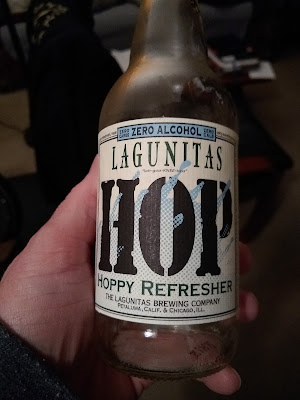
However, one of the options I enjoyed the most was the Hoppy Refresher from Lagunitas. It is basically a hop flavored seltzer and was actually created for the Lagunitas employees. One of the perks of working for a brewery is free beer, but that doesn't work out so well when you are on the clock. The company created this to hand out instead, and it was such a hit they started selling it to the public.

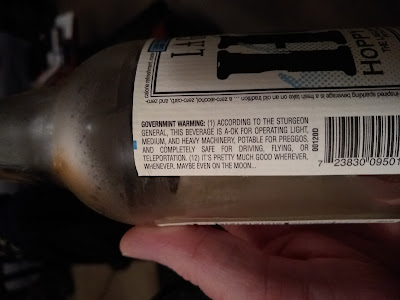
The hop seltzer is its own thing, not trying to pretend to be beer. Often a substitute that isn't trying too hard at replication is actually more interesting. For example, I would much rather have a Garden Burger than an Impossible Burger. The Hoppy Refresher even has this great, non-Surgeon General warning. 

click to embiggen

One new addition to the lineup this year was gin substitutes. I do love me a gin and tonic, and I have found a couple of NA substitutes that are quite enjoyable in a mocktail. One odd thing is that the non-alcoholic versions are more expensive than the real thing, sometimes almost double the price. Clean(ish) living isn't cheap. 

Were there any lessons or morals to the story in not drinking for a month? Not really. No epiphanies were had, I didn't lose a bunch of weight, and I didn't feel more rested in the mornings. As with previous Dry Januarys I have participated in, it was mostly concrete goal to start the year, and a check against habits running in the background. You can't change habits you don't pay attention to, and over all it is just good to pay attention.

There was one clear benefit this year. When I was mostly separated from friends in January, it was nice sharing this common goal with the group. We'd check in through text or through video on Marco Polo, swap stories and drink suggestions. It was good excuse to reach out. I kept us connected in a different way during a month that is statistically the most depressing.  

Will I do it again? Probably. But there are plans this weekend to see friends and enjoy an adult beverage together. In person. 

December 30, 2021

Planning for failure, and still falling short

 So to recap from my last post (you may want to read it first), I:

  • Went to the Oceanside Half Iron seriously under-trained.
  • Planned not to do the run, so I was never going to "finish".
  • Still had mild delusions of grandeur.
  • Had a tough go of the swim, including five minutes of cramping and treading water.

The last leg of the swim was in the harbor and was more protected, so the water was less choppy. I swam slowly, trying not to set off another cramp, and made my way toward the boat ramp and finish line. Even with my slow going, there were still plenty of other swimmers around me, so at least I wasn't going to finish dead last.

I reached the boat ramp and was finally able to stand up again. Instead of heading across the finish line and timing mat, I made my way to the small dock to the right of the ramp. I was very nauseous and did not trust myself to stay upright. A volunteer was at my side almost immediately and asked what was wrong. I said I just needed a few minutes, but she stayed by my side. 

When the nausea did not pass, they encouraged me to get up on the dock. As soon as I did, I felt like throwing up, so I stretched out flat on the dock. Then my leg started cramping again. When that cramp settled down, another would fire up. I spent a long time vibrating in pain, flopping around like a fish out of water, all the while trying to roll over on my stomach so I could throw up (never did though). 

Medical staff was there, again almost immediately. They kept asking what was wrong, but I was at the mercy of the pain of misfiring muscles, and couldn't get out much more than a couple of words. Calves and hamstrings seized and cramped while they tried to stretch things out. I felt helpless, though I was surrounded by people trying to help. 

After what seemed like ten minutes, they got me upright and walked me to the medical tent. They set me down on a cot, asked questions, and peeled off my wetsuit so they could take my blood pressure. Various muscles would cramp, but things were starting to settle down. I eventually sat up, and they handed me a Gatorade to get some sugar and electrolytes in my system. 

In the cot next to me was another swimmer. I am not great at guessing ages, but she was probably my age or maybe a bit older. She was shivering violently as the medical staff tried to warm her up. I saw her hand trembling and reached out to hold it. I just wanted to let her know someone was there. I put my head down and started weeping. 

I held her hand for a while. Her body stopped shaking quite so much and was down to a slow shiver.  I left my cot to free up space in case there was someone else who needed it. I gathered up my wetsuit and goggles, thanked everyone I could make eye contact with, and limped back out to where my bike was parked. Someone asked if I was planning on riding and I laughed. No, my day was done. 

It probably wasn't all that cold, but I was shivering in my wet clothes. I had sent off my dry clothes to the finish line, but fortunately I had left a hoodie behind. I dried up the best I could, put on my running (walking) shoes and made my way out of the transition area. I had about three hours to kill before my buddies would be finished with their bike ride. 

I found some breakfast, found a pub with some tables right next to the course, chatted with another person waiting to cheer on a friend, and sent texts to the people who were following me online to let them know why my tracker wasn't moving. And I tried to digest what had just happened. 

After talking to someone later, I think I had a rush of adrenaline when I was cramping and treading water, and my body did not have time to clear it until I hit dry land. As soon as I was safe, it crashed down on me, and my body let me know in no uncertain terms that I needed to listen to it. 

Ironman has a pretty good tracking app so I was able to estimate when my buddies would be passing by. I saw both of them come in on the bike and then head out for the run. I walked along the course toward the finish line to pick up my dry clothes, and spectators kept cheering me on as if I was still a participant. After the first few it was just easier to thank them rather than explain what was going on. 

I was able to see my buddies a couple of times on the run course, and then headed to the finish line to watch people come in. A finish line is really something special. All the stories of how their day went, and what it took to get there, are often written on their face. I cheered every one of them on. Some were coming in strong, some were stumbling. Some wore a face of determination, others you could tell were about to cry. When they cried, I cried. 

When my buddies crossed the line, we swapped stories of our days, the good and the bad. That part is always great. People run the same course, but everyone runs a completely different race. 

After having time to think about my experience, I don't really regret trying. I was never going to do the run, so it was always going to be a DNF (Did Not Finish) for me. It took the pressure off of any sort of goal time or performance. I planned to take it really easy. I wanted to just enjoy participating at an event after more than a year and a half of shutdown, and doing the event with friends. 

Still...

Grit has carried me through difficult events before, but grit and determination can only go so far. I never want to show up that unprepared again. I think I am also done with any event that involves an ocean swim. Difficult events always involve a bit of suffering, but I don't ever want to have that feeling again of hating what I am doing. Now in the future when I utter the phrase, "Well, I've done stupider things...", I think this will be the 'thing' that pops to mind

I hope to never eclipse it. 

August 7, 2021

The road ahead looks very different

 In 2019 I took up triathlon. It was something I had been meaning to do for years. I suppose it seemed somewhat inevitable after running and biking for the past fifteen years. An Ironman had been a bucket list kind of item for years, but procrastination postponed my getting in the pool and tying the sports together. Inevitable or not, it felt shiny and new. 

And I loved it. 2019 was the most excited I had been about sport and exercise since I suppose my peak efforts between the fall of 2012 and the summer of 2013 (marathons on two consecutive days, then one-day STP and Ramrod a week apart). In the summer of 2019 I went from Googling triathlon information to doing a sprint distance, an Olympic distance and a half Ironman distance within three months.

I was hooked, and excited for the following year. I ultimately signed up for two Half Ironmans and one full Ironman for 2020. Then of course, 2020 happened. "And then 2020 happened" has been said and written thousands of times, and I have a feeling it will stay in the vernacular for a long time. 

Things didn't get cancelled all at once, so there was training and cautious excitement for a few months. Then as it became clear that the show(s) would not go on, I found some other challenges and reasons to stay on the road and in (relative) shape.

And then 2021 happened.

After a run on January 5th, I was sick for several days. These days whenever I feel off, I fear the worst, but thankfully the Covid test came back negative. At the same time, Mom had been growing more sick since Thanksgiving. I had been going over to their house four nights a week to help out, and with each visit it was more difficult to have hope. The visits and tax season hours made getting in a run more difficult, but I think the lack of hope spilled over into feelings of "why even bother." I didn't run another step until late March.

When I started running again, everything seemed to hurt. This is pretty typical after a long layoff, but it wasn't just that sort-of-satisfying muscle soreness from getting in a workout. The pain that lingered started with what I thought was a hip flexor issue. I took time off, I stretched, I massaged with a foam roller, and when none of that worked, I tried running through it. Running through it has worked at times in the past, but not this time.

The pain then spread and increased in frequency. My right thigh muscle would quiver and I would occasionally get shocking pain in my right hip and IT band, buckling my leg out from underneath me. My body was failing me, and the hopeless feeling settled in. 

After trying all I could think of on my own to improve things, I finally decided to go to the doctor. I was due for a check up anyway, so I could ask about my leg pain while taking care of that. My previous primary care doctor had recently moved out of state, so it took some time and hoop-jumping-through to get a new doc and appointment. 

I saw the doctor on Tuesday. He already had my bloodwork results, and other than cholesterol that is a bit high (but not high enough to require medication), nothing was out of order. We chatted a bit about other health items, and I received a general thumbs up for my health as a 54 year old. 

We started talking about the leg pain I had been experiencing. At the outset he suggested physical therapy, and honestly getting a referral was another reason for my visit. He then checked my range of motion, find where I would grimace in pain, poked and prodded while asking additional questions. He thought it was unusual that the pain had been going on for this long, so he recommended getting an X-ray. I walked down the hall and took care of it immediately.

To too late cut a long story short, the doctor called an hour or so later and told me that they found that I have moderate to severe arthritis in my right hip. Googling told me that moderate is level 3 and severe is level four. The scale only goes up to four.

I took the news pretty hard. I don't know what this means long term for my mobility, and more specifically my running. As I have written about for years on this blog, running is a big part of my life, a big part of who I am. It of course has made me physically stronger, and I have relished taking on challenges, seeing how the limits I think I have can be pushed through. Running has also done wonders for my mental well being, and I have already been suffering the consequences of its absence these past six months. 

Running was also a big part of my future plans. I would complete that Ironman. I would notch that 20th marathon, and then keep going. I would see what all the talk about ultras was about. I would do that relay run, splitting some 200 miles between twelve (or maybe even six) companions. I still want to be that 70 year old guy that shows up at the local 5k every year. I want to see more start lines. Beyond running, I want to continue to backpack and take on the Wonderland Trail someday (if they ever grant me a permit).

After the doctor's call, I left work early and went for a walk. I walked the Kirkland waterfront and rail-to-trail loop that I have used so often on my training runs. As my mind spun, I tried to begin processing what it meant, what I was feeling. To find my feet, as it were. In those first few hours, all I could see was loss, and hope fading once again.

I left the trail to return to the waterfront, randomly turning down a street I had not walked on before. A couple of blocks later, I saw this book in the planting strip by the curb.


Well played universe. Well played.

I was fortunate to get an appointment with a physical therapist the next day (there was a last minute cancellation). The PT was not ray of sunshine, "we can conquer anything" enthusiastic about things, but he was encouraging. The PT did his own evaluation of my mobility, walked me through some recommended exercises, and put our next two appointments on the calendar. I tried not to press him for outcomes so soon in the process. He did hint that marathons may be in the past, but he did not write off running entirely.

This is all new. To be frank, I am still working through the freaking out/distraught stage of things, but I am moving toward finding the path forward. It will take a different kind of hard work. My training calendar will be filled with more PT exercises than events, but I will also be squeezing in more non-impact biking and swimming than planned. 

Yes, I am happy and fortunate to have generally good health, and there have certainly been larger losses for me this year, but this still hurts, and I am going to sit with it for a bit. 

June 13, 2021

Dry spells

A friend of mine announced in December that she was pregnant. A few of us were at their house to have a sort of a pod-safe gathering ahead of Christmas when they told us the news. After some cheering and rule-breaking hugging, we talked about what life would be like for them in the year ahead.

This being our biking group, we quickly recognized that the due date was right around the time we were signed up to ride Ramrod in July. The soon-to-be father was obviously out, and the rest of us more or less decided that we would train, but if the baby decided to show up on race day, we would skip the ride to be at the hospital. 

As we continued to chat, the mom-to-be mentioned that she had been filling the fridge with new non-alcoholic beverages to replace the wine and beer she was giving up, and she asked for other drink suggestions. I suggested we all give up drinking for January as a small show of support. 

I have participated in "Dry January", no alcohol for the month, a number of times. It is a reset after the holiday indulgence, and a check-in to make sure that setting drinking aside is as easy as it should be. This time around, even though it followed nine months of sheltering in place where drinking was more of a temptation, it was remarkably easy. 

I did have one slip up mid-month. My brothers and I had found a restaurant with an open outdoor patio, and we got together to discuss Mom's current condition, and I suppose to check in on each other as well. We were about an hour in when I shared that I had given up drinking for January. I said this while taking a sip of my second beer. 

I had just completely spaced, falling into a routine, I suppose highlighting that habits run along in the background unless we consciously make the effort to change them. I wasn't giving into a craving, just drinking without thinking. I added on four or five "dry" days at the beginning of February to offset the slip up. 

Unfortunately, three better habits have also gone dry this year. A slight modification of the grade school three Rs they are Reading, Writing and Running. These three habits are a big part of what keeps me healthy in both body and mind. My writing has obviously been neglected for quite some time, but through the 2020 part of the pandemic, I managed to keep up the other two when the world was turned upside down and making less and less sense. I was able to read 26 books last year, and though I had grander plans, I ran semi-regularly and covered a little over 500 miles. 

2021 has been an absolute struggle on all three fronts, and to be honest I am just plain struggling. I'll pick up on the running dry spell in the next post. 


January 24, 2021

Mom

 This is a post I have been avoiding writing. In a similar way, when my marriage was crumbling I didn't write about it publicly, maybe hoping to put off the inevitable outcome, and keeping it to myself in the meantime. But like so many things I have written about here, avoidance and trying to go it alone only leads to deeper troubles. Unable to see most of you in person these days, I will start the process here, beginning to work through it by getting it out of my head and down on paper.

Mom has cancer.

My brothers and I have been meeting once a month off and on over the last couple of years to grab a beer and catch up on life. This has obviously been paused during the pandemic, but in late October a gathering was called, and we were told about the diagnosis. 

She has been diagnosed with Multiple Myeloma, a cancer that forms in white blood/plasma cells. It accumulates in, and attacks your bone marrow. It was discovered when my mom was having back pain. After a couple of appointments, they discovered she had some broken ribs. This made them look a little closer, and they found the cancer, which had been basically dissolving the bones. As a strange coincidence, though multiple myeloma is a relatively uncommon cancer, this is the same type of cancer that my former father in law had. 

The cancer is in the later stages, and the outlook did not look good on initial diagnosis. Mom was put on a chemo regimen, taking a pill once a day in three week cycles. In the beginning, Mom was in a lot of pain due to the broken ribs. Every movement seemed to hurt, and she was very frustrated. Unfortunately, a few days before Thanksgiving Mom went downhill rapidly. She was lethargic, somewhat unresponsive and been sleeping most of the day. 

She was taken to the hospital the Tuesday before Thanksgiving and was there for a week. We brought her back home, hired in-home healthcare to help during the daytime, and I moved in to help out in the evenings. She briefly improved, but a couple of weeks later she was back in the hospital for another two weeks, coming home the evening of Christmas Day. 

Of course, since this is all happening in a pandemic, she couldn't have any visitors while she was in the hospital. We weren't even allowed in the building, so she was going through this all alone. I can't fully understand what that was like for her. They released her on Christmas, not because she had improved much, but because they weren't getting anywhere in improving her physical health. She was too weak to be moved to skilled nursing care, so home was the only real option.

She has been home again for almost a month now. On one hand, being at home is better for her mental state, and her ribs seem to be mostly healed. However, she is still weak, unable to do much more than lie on the couch during the day, and often has difficulty following trains of thought. Strangely, her decline does not seem to be directly related to the cancer, as those numbers seem to be responding to the chemo. It has basically been diagnosed as "failure to thrive", a phrase that seems to put it all on her (and us). She definitely isn't eating or drinking enough, and that is contributing to the inability to get better. I don't know if it is a confluence of the multiple drugs she is on that is making her not want to eat, or if it is something else.

We are trying our best. There is still a healthcare worker there during the day, and one of the brothers is over there every evening to see Mom, and help Dad out with her evening care. But we are at a loss right now. We aren't seeing any real progress, have fewer answers, and we just generally feel helpless. 

There is much more to process and work through, more detailed stories to tell, but this is a starting point of where we are right now. Thanks for reading, for being a part of my circle, and for being part of the conversation.

As always, hug your humans (when it is safe to do so). 

December 3, 2018

The pain of deferred maintenance

I was at the dentist three times last week.

Two of the appointments were to scrape away years of build up, and one was to replace a filling that was partially failing. As I sat in the chair, I let my mind wander. Because of conversations I had with someone recently, and for the mind's ability for free-association and metaphor, I thought about my marriage and the counseling we attended as it unraveled, while the technician dug in and occasionally touched a nerve.

We went to a marriage counselor for four months. The counselor was legitimately terrible, at one point saying "we are not here to save your marriage." Even so, there was some benefit into digging into the issues and neglect in our relationship. I have never been so raw and exposed as I was then. I can credit that time for changing who I am and how I approach relationships, romantic or otherwise. I can still be a somewhat private person, but I am leaps and bounds more open about my fears, feelings, failings and fractures.

I saved this some time ago. Sometimes you see a meme or quote that speaks to you and expresses something you've been feeling but couldn't quite distill. You see it and and think "yeah, that is it".


Then you read it the next day and think, "well it isn't that simple but this totally explains part of it."

Even after months of counseling and painful digging into the neglected parts of our hearts and feelings, I never got an answer as to why she felt our marriage was not salvageable. Because of this, and my propensity to self-analyze/blame, I tore into the wounds opened in counseling before they could scab over. I desperately wanted a 'why' and I could only examine myself at that point. On the one hand, the lack of an answer made me question everything about myself, and there was some growth as a result. On the other, it definitely delayed my recovery.

I was asked the other day if I missed that relationship. I didn't have a particularly satisfying answer.  As I have written before, I do not know if that was my one or best chance or not, but contrary to the meme I do not think, "I am not over her." I suppose I miss the promise that it held, and mourn the way I/we let it fail. That said, I recognize that relationship is long gone, we are both very different people now, and I do not think on its loss much anymore.

At one time I imagined that my ex and I would sit down over coffee or wine some day and speak freely about the 'why' once sufficient time had passed. I am actually seeing her in person for the first time in nine years in just a day or two. I do not know what to expect, except that this meeting is just perfunctory. There will be little time to do anything but awkwardly chat, and no revelations will be forthcoming.

With the time that has passed, I feel less and less that I need a 'why' in order to fully heal and close that chapter. I so desperately needed it back then, but I don't know that it would help me as much now.

But damned if I am not still curious.

Much like my dental care, my mental health care cannot be a once-a-decade check in. Massive healing can happen if you choose to sit in the chair with professionals after avoiding them for so long, but a lot less blood is shed with regular maintenance and upkeep.

As I look to the possibility of new relationships, I must maintain my desire to improve, and trust that healing is the result of all the work that was done.

And don't forget to floss.


September 23, 2014

Walking path

"In the city, Harold's thoughts had stopped. Now that he was back in the open land, he was once again between places, and pictures ran freely through his mind. In walking, he freed the past that he had spent twenty years seeking to avoid, and now it chattered and played through his head with a wild energy that was its own. He no longer saw distance in terms of miles. He measured it with his remembering."
 ~ from The Unlikely Pilgrimage of Harold Fry by Rachel Joyce

Work has been crazy lately. This was not unforeseen, as we have very defined deadlines we can mark out on the calendar at the start of the year. No matter how much we try to prepare, there is always a mad rush at the end. We can be seen skidding through then narrow opening as the heavy door comes crashing down a la Raiders of the Lost Ark, and we can only hope to have made it with hat and head intact.

Monday September 15th was the latest deadline, and we finished the last project around 9:00 at night, three hours before the midnight deadline. After a couple of weeks of long hours and working weekends, I was offered a random Tuesday off to recover and recharge. The clock has already started ticking on the next deadline, but sometimes you need to take a break to avoid breaking.

I slept in a bit, but my fried brain still had enough energy to chatter me awake too soon. I decided to go out for breakfast, and made it that much better by walking there. I have found that I need to get outside to balance out the desk time, but let that knowledge slip away as deadlines loom overhead like a guillotine. A walk in the sun would do more for me than the coffee waiting at the diner counter.

I slipped on some headphones and fired up the latest U2 album. The album had been given away free to all iTunes users as a promotional stunt at the latest Apple launch. I won't be buying an iPhone any time soon, but was happy to walk away with a little bystander swag.

Though I have been doing a bit of hiking and biking lately, I have really lost touch with my active self. A bout of Plantar Fasciitis in May kept me from running, and then the round of shingles forced me to pull back further to allow my body to heal. The shingles are gone, but the heal pain lingers. That has been discouraging, but more troubling is the loss of drive to recover my former self.

I have had a couple of anchors the last few years that have kept me (relatively) sane, and I have let them both slip away. Both writing and running help to keep my mind and soul clean. I have turned away from both, and I am dealing with the consequences. Netflix binges have pushed out time to write, and I have been filling in empty spaces with too much food and drink. I am fifteen pounds heavier than I was at the beginning of the year, but it is more than just a physical weight that I feel. I have known the solution, but at times those first few steps or words are the most difficult.

So instead of trying to run, I walked.

Forward motion. Music. Lyrics. A gift of a day unexpected. Sunshine. Fresh air. All had their part in shaking loose some of the jangled thoughts and emotions that had built up over the summer. Breakfast was served with a friendly face, and coffee and bacon did their own trick of service. Afterward, I wandered down to the river path and stood and watched the ducks preen and swim in lazy circles.

In the afternoon I would meet a friend for an impromptu hike, conversation and climbing peeling back another layer. In the evening, I would meet my two brothers for a drink, and find further connection and renewal there. We did not find the meaning of life as the subject line of the coordinating email implied we might, but we did find life at our booth on a random Tuesday.

I can get lost so easily on such a familiar path, especially in the busiest times when my head is down, just working to make it through the next real or imagined gateway. Running and writing have been my compass in the past. They don't always point me in a specific direction, but they definitely mark the path away from a place I shouldn't be.

Baby steps.

June 29, 2014

Shingles, and not the roofing kind

So, I get a shingles diagnosis to add/confirm to the feeling of getting old. Even though I guessed right on my diagnosis, I really didn't know much about it (other than it side-lined David Letterman a few years back). The quick stuff I read before heading to the doctor was not encouraging. I will dig more into it, but here is what I know so far.

Shingles is caused by the virus that gave you chickenpox as a kid. In some people, it reactivates later in life, causing shingles. From WebMD,
"Early symptoms of shingles include headache, sensitivity to light, and flu-like symptoms without a fever. You may then feel itching, tingling, or pain where a band, strip, or small area of rash may appear several days or weeks later. A rash can appear anywhere on the body but will be on only one side of the body, the left or right. The rash will first form blisters, then scab over, and finally clear up over a few weeks. This band of pain and rash is the clearest sign of shingles." 
After reading that, I went down my own list of symptoms. I definitely had the pain, red rashes and it was only affecting my right side. After clicking on a few pictures of sample rashes (I will spare you), it seemed like I was a candidate, even though the rashes more typically shows up on your torso first. Off to the doctor.

After looking me over, and asking a few questions, he confirmed that it was shingles. I don't have a regular doctor, so I wasn't sure how this guy would react to a patient coming in with his own diagnosis. I am sure with the ease of access to information, they get flooded with amateur doctors pretending to know what they are doing after ten minutes on the Internet. Unprompted, he said he appreciated how involved people are in this area in managing and researching their health. We chatted for a bit and he filled me in on what to expect.

Shingles is a viral disease. Once your bout of chickenpox runs its course, the virus remains latent in your nerve cell bodies. Years or decades later, the virus can break out of the nerve cell bodies and travel down the nerve to cause a viral infection in the skin area served by those nerves. The infection can spread within nerve cell clusters, but seems to stay to one side of the body (beyond my understanding of anatomy to know why).

The skin infection becomes painful, I assume because the infection is in the nerve. The rash eventually blisters, and this is when it could be contagious if someone were to come in contact a broken blister. From what the doctor said, though, the chickenpox virus is all around us already, so there is no need to really quarantine yourself.

He confirmed those phrases that no one wants to see connected with what they have - "we're not sure what causes it (the outbreak after dormancy)" and "there is no cure". The regimen is about trying to minimize and shorten the symptoms. I am on an anti-viral medication as well as a corticosteroid for the next week or two. The doctor said that the addition of steroids is somewhat controversial (in that the benefits are not clearly proven), but he said that on a risk/reward basis, the steroids could reduce the incidence of scarring and other long-term effects. He also said if I get snippy with someone, I can blame it on him/the steroids. I am thinking about having cards printed up.

The pain and rash typically subside within three to five weeks (your results may vary). The concern, beyond some possible scarring, is a condition called, Postherpetic neuralgia, a condition of chronic pain following a shingles outbreak. This apparently happens in one out of every five people, though more frequently in those over 60. Per Wikipedia, it affects closer to ten percent of those under 60. Postherpetic neuralgia is the damage to the nerves in the skin where the rashes appeared, causing them to send abnormal signals to the brain. "These signals may convey excruciating pain, and may persist or recur for months, years, or for life." Here's hoping I am not one of the 10%.

So, now you know as much as I do. It definitely hurts, with a lower-grade ache punctuated with some stabbing pain, and a burning sensation at the rash points. I am hoping that the anti-virals and steroids cut the time it takes for shingles to run its course, and really hoping there are not significant lingering effects. For now, since one of the hot points is in the palm of my right hand, I will work on improving those ambidextrous skills.

Cresting the rise

I have been feeling broken down lately. I have plantar fasciitis pain that has kept me from running for two months. I am currently wearing a boot to bed to try to keep the tendon stretched out. My right wrist started hurting the other day, so I had my carpel tunnel brace on as well. Pieces of me encased in hard plastic to keep me from hurting myself while I am sleeping. Danger, fragile!

On the last couple of bike rides, I have felt like I just don't have it anymore. I was climbing the last hill on the Seven Hills of Kirkland ride last month, which was actually the ninth hill because we opted for the longer route. I was really struggling. It is a difficult ride, but one I tackled well last year. As I tried to will myself up the hill, I wondered if my peak days were behind me. Was I now "over the hill" physically now that I can't climb this one. There was another tough ride a couple weeks later that felt harder than it should have been.

Intellectually, I know the day is coming where the times on the stopwatch will only increase. There will be no further personal best times, and the challenge of events will become something else. I do want to be that 75 year-old guy that is still out there running, and showing up at 5ks for the enjoyment of it all, race times be damned. Emotionally, though, I am not quite ready to give up. I still want to feel like I am on the up-slope of that metaphorical hill, even if I am climbing it more slowly.

Everyone has their own definition of when they are "old". Maybe it is a number, maybe it is an activity you no longer can do, or it could be the number of pills or splints it takes to keep you moving. My semi-joking line is that when I no longer sleep in a tent with just a Thermarest between me and the ground, then I will feel old.

I tested my "old" theory again this weekend. A few of us went on a "test" hike before our return to Delta Lake in August. A couple of us wanted to test out our new packs, and we all wanted to check our fitness  level before scrambling off the maintained trail. We hiked to Copper Lake, no small undertaking in itself, but ended up getting rained out and coming back early. It turned out to be a good thing.

My right arm had been bugging me for a couple of days. It felt like a nerve pinch starting in my shoulder, maybe from planks I had been doing during June. Thursday and Friday, I started noticing red blotches on my arm and hand. They were more painful than itchy, and I jumped online to check on the symptoms. There was a recent measles outbreak in Washington (thanks anti-vaxers), as well as an increase in Lyme disease from tick bites (though I hadn't made it to the woods yet). Nothing quite lined up, so I headed to the hills Friday morning.

Sunday morning, the pain and blotches were joined by some numbness in one finger, and swelling in another. Another possibility dawned on me, and after some more WebMD surfing, it was off to Urgent Care. My Internet research turned out to be right, unfortunately (I hate it when I'm right). I have shingles.

More on what that means in the next post, but just the diagnosis of "shingles" has me feeling pretty old. I am not giving up on on that hill just yet, but it does feel like I am starting to crest the rise.

July 18, 2012

Running and weight

I have pretty much always been overweight. As a kid, I shopped in the "husky" section that had nothing to do with our local college team. Growing up, my brothers were taller and leaner, and I was the more round guy on the end, the 'o' to their 'i'. I was not particularly active as a kid, though I did play youth soccer for some seven or eight years. But when I tried out for the junior high team, I washed out in the first couple days of tryouts because all we did was run. We didn't get to soccer skills until the last hour of the second day, and by that time I was finished.

Fitness and activity didn't come until later. Most every job I have had required me to be on my feet, and my decade-plus in construction has made me stronger just by going to work. Biking was my first extracuricular activity, and two years after that I was running. I ran my first 5k in March of 2005, and my first half marathon that November. I hadn't prepared terribly well for the half marathon, but the experience of the day, and crossing that finish line hooked me. I wanted to take this more seriously and prepare for a full marathon.

I was still pretty heavy at that point, but far from my heaviest. Before I started running (I think I had just started biking), my former wife bought me a scale one Christmas. It was one of those fancy models that not only gives you your weight with half-pound, digital precision, but it also estimates your body fat percentage by sending a small electrical charge through your body. I don't remember precisely what it read that first morning, but the weight was north of 190, and the fat make-up above 30%. I had no illusions that I was skinny, but those numbers were pretty shocking. What was worse was when I plugged my numbers into an online Body Mass Indicator (BMI) calculator. I was not only overweight, but I had moved into the "obese" catagory.

Damn.

Back to 2005. Just after the half marathon, I started my plans to run a full marathon. Looking at some training plans, I would now be running 20, 30, or 40 miles a week. If I could stick to it, I knew I would be in the best shape of my life by the time I showed up at the start line. I imagined that the pounds would fall away as the miles went by. I even took a  "before" picture I could compare the glorious "after" person I would become. Shield your eyes, 'cause here it is:


For several months, I followed the training plan and slowly built up my fitness. Then a month or so out from the marathon, I got injured. I didn't know it at the time, but it was a classic IT band issue. I still showed up at the start line, but only made it 18 miles. I would finish a marathon five months later, mostly on grit and biking fitness.

So how about that physical transformation? I was definitely fitter, but the weight did not melt off like I had anticipated. I went back and looked at my running diaries, and I weighed in at the exact same 175.5 pounds a few days before the marathon, and I had somehow managed to gain a point of fat percentage. Over the next few years, the miles increased, but the weight stayed the same, or even climbed. In 2007, I ran 660 miles and I was carrying the exact same 182 pounds in December that I was on January 1st (that handy fat percentage meter kept me from believing that I was exchanging fat for muscle).

In 2008, I ran another 650 miles, but nothing much happened with my weight until the last two months, when my marriage frayed and I started running for UPS every day. After that difficult November and December, I finished the year about ten pounds lighter, I managed to maintain that loss for most of 2009. But after running a lifetime high of 928 miles, I was again back up to 176 on December 31st, a half pound heavier than my optimistic "before" picture four years earlier. What had become crystal clear is that exercise is not enough.

Not that this isn't completely obvious, but it comes back to calories coming in versus calories being burned off. I had been burning more calories for four years, but I was clearly consuming more as well. Part of the problem is the illusion that you can eat whatever you want after a long workout. Unfortunately, it doesn't add up that way. I would need to run about 28 miles to burn the calories in a single pound. By not paying attention to what I was eating, I was essentially running in place.

I heard on a podcast (can't remember which one) about combating childhood obesity. Today one in five kids are obese (triple that of 30 years ago), and many more are overweight. The study asked the question of where the best place was to start - exercise or nutrition. If you eat better and weigh less, you might be more inclined to move around more. The other side of the coin is if you move around more, you might be inspired to take care of your body and eat a little better. The study found that children were more successful if they started with the food side of the equation. Exercise is clearly important, but what you put in your body is even more important.

2011 was the year of the 30 day resolutions, and cutting out alcohol, fast food, meat, and making better food choices in general were some of the monthly challenges. As a result of those changes, I lost another 12 pounds during the year and I have managed to keep them off. Both the exercise and making good food choices are about taking better care of myself, and they were finally reinforcing each other.

160 pounds is now the number I dance around, and the 30 days of running helped push me below that. This is the "after" picture, about six years later than planned.


From this angle, the most noticeable difference is in my face (and of course my California tan lines). This is me at 155.5 pounds, and 21% body fat. Nothing like a Biggest Loser transformation, or even particularly skinny for my height, but still it is a difference of 20 or 40 pounds depending on the starting point, and 9 points off the fat scale. The miles of running, biking and that fancy scale have seen me move from obese, through overweight, and into the high end of normal on the BMI chart. At six years older, with the accompanying slowing metabolism, I'll take it.

There was no "diet", just dietary change. I still indulge, but the overall pattern is different. I understand that one day of exercise or one meal doesn't make or break it for me, and that it is how they all interplay over the long term.

Occasionally, the solution is very simple, but that doesn't make it easy. Even when you know the solution, you aren't always prepared to take action.  Running wasn't the silver bullet, but it improved my outlook and set me on the road to taking better care of myself. Everything played its part, but in the end it turned out to be a bit more about the meals than the miles.